Procedure guide
Breast Lift (Mastopexy) in Korea
- Surgery time Around 2 – 3 hours
- Anesthesia type General anesthesia
- Hospitalization 1 night
- Face wash & makeup 3 days after surgery with waterproof bandages
- Post-surgery check-up 2 times (depending on the patient's condition)
- Stitches removal 7 – 14 days after surgery


A breast lift, or mastopexy, reshapes and elevates breasts that have sagged due to ageing, pregnancy, breastfeeding, weight fluctuations, or gravity. The procedure removes excess skin, tightens surrounding tissue, and repositions the nipple-areola complex to a more youthful height. Unlike breast augmentation, the primary goal is not to increase size but to restore shape, projection, and firmness — though implants or fat grafting can be added if volume enhancement is also desired.
Korean plastic surgeons bring a meticulous, aesthetics-driven approach to mastopexy, with particular skill in minimising scar length and achieving a natural breast contour. Seoul clinics cater extensively to international patients, offering bilingual coordination, advanced surgical suites, and follow-up protocols designed around medical-travel schedules.
| Surgery time | 2 – 3.5 hours |
| Anaesthesia | General anaesthesia |
| Hospital stay | 1 night (sometimes day surgery) |
| Back to routine | 10 – 14 days |
| Final result | 6 – 12 months |
This page is for informational purposes only and does not replace a professional medical consultation. Individual results vary depending on breast anatomy, skin quality, and surgical technique.
How it works
The technique your surgeon selects depends on the degree of ptosis (sagging), breast volume, skin quality, and your aesthetic goals. Here is a general overview of the surgical steps.
- Planning. While you are standing, the surgeon measures breast dimensions, marks the new nipple position, and outlines the skin to be removed. Common patterns include periareolar (donut), vertical (lollipop), and inverted-T (anchor) — each producing a different scar footprint based on how much lift is needed.
- Anaesthesia. General anaesthesia is standard for mastopexy. An anaesthesiologist monitors you throughout the procedure.
- Access. Incisions follow the pre-marked pattern: around the areola only (mild sagging), around the areola plus a vertical line to the breast fold (moderate sagging), or adding a horizontal line along the breast fold (significant sagging).
- Reshaping. Excess skin is removed, breast tissue is reshaped and tightened with internal sutures to create a lifted, rounded contour, and the nipple-areola complex is moved to its new, higher position. If combined with augmentation, an implant or fat graft is placed at this stage.
- Closing. Incisions are closed in layers with absorbable deep sutures and fine skin sutures or adhesive strips. Drains may be placed temporarily. A surgical bra or compression garment is applied immediately.
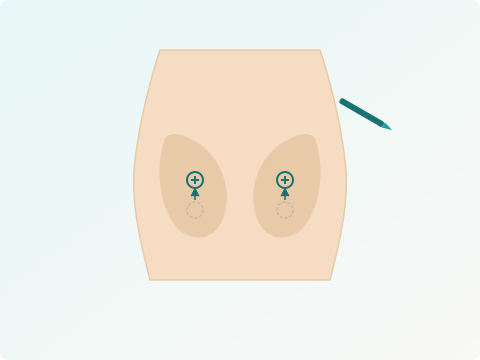
Breast assessment & marking
With the patient standing, the surgeon marks the new nipple position, breast meridian, and skin excision pattern based on the degree of ptosis.
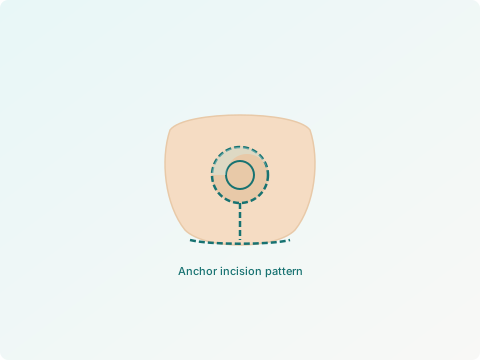
Skin excision & reshaping
Excess skin is removed according to the marked pattern (periareolar, vertical, or anchor). The breast tissue is reshaped and lifted on its blood-supply pedicle.
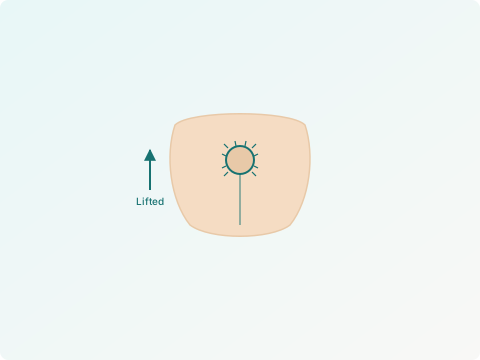
Nipple repositioning
The nipple-areola complex is moved upward to its new, higher position while maintaining its nerve and blood supply through the preserved tissue pedicle.
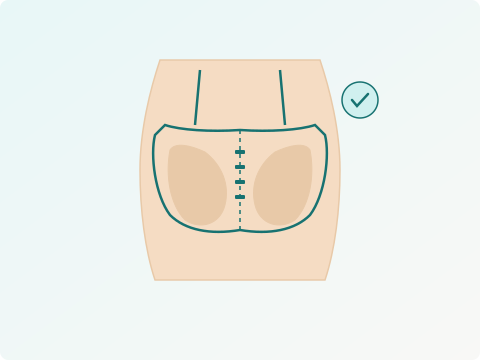
Closure & support
Internal sutures support the new breast shape. The skin is closed in layers. A surgical support bra is fitted immediately to maintain the lifted contour.
Cost · as of 2026
Through Seoul Medical Insider, breast lift surgery is quoted transparently with no middleman markup. Your estimate includes the surgeon's fee, anaesthesia, operating facility, one night's hospital stay, surgical garments, and any combined procedures such as implant augmentation or areola reduction.
The cost of mastopexy in Korea varies depending on the technique (periareolar lifts are less complex than anchor-pattern lifts), whether implants or fat transfer are added, and the surgeon's level of specialisation. Even at Korea's most reputable breast-surgery clinics, patients typically pay 40 – 60 % less than they would for the same operation in the US, Canada, or the UK.
All pricing is reviewed and updated for 2026. Contact us with photos and a description of your goals for a personalised quote.
Who it is for
A breast lift addresses shape and position rather than size. Determining whether mastopexy — alone or with augmentation — is right for you starts with an honest assessment of your anatomy and goals.
- Suited: Women whose nipples point downward or sit below the inframammary fold, indicating moderate to severe ptosis.
- Suited: Patients who have lost breast volume and skin elasticity after pregnancy, breastfeeding, or significant weight loss and want to restore a firmer, uplifted shape.
- Suited: Women with asymmetric breast sagging who want to improve symmetry in nipple height and breast contour.
- Suited: Those who are at a stable weight and do not plan future pregnancies, as pregnancy and weight changes can affect long-term results.
- Discuss carefully: Patients who primarily want larger breasts — augmentation alone may be sufficient if there is minimal sagging.
- Discuss carefully: Women who are concerned about visible scarring — while scars fade significantly, they are permanent. Periareolar techniques minimise scarring but are only suitable for mild ptosis.
- Discuss carefully: Active smokers — nicotine impairs nipple blood supply during healing and significantly raises the risk of wound complications.
Recovery
- Week 1. Breasts are swollen, bruised, and feel tight in the surgical bra. Drains, if placed, are usually removed within 2 – 5 days. Pain is managed with prescribed medication. Avoid raising arms above shoulder height. Sleep on your back in a slightly reclined position.
- Weeks 2 – 3. Swelling begins to subside. Sutures are removed or dissolve. Light walking is encouraged; desk work can typically resume around day 10 – 14. The surgical bra should be worn around the clock.
- Weeks 4 – 8. Breast shape continues to settle. You can transition to a supportive sports bra. Light exercise (walking, stationary cycling) is usually permitted at week 4; upper-body workouts should wait until week 6 – 8.
- Months 3 – 12. Scars progress from pink/red to lighter tones. Final breast shape, nipple position, and scar maturation are evident by 6 – 12 months. Silicone scar sheets or gel can help flatten and fade scars.
International patients should plan to stay in Seoul for at least 10 – 14 days to cover drain removal, suture checks, and a final clearance appointment before flying. Long-haul flights within the first week are not recommended due to swelling risk. Seoul Medical Insider will help you plan a realistic recovery schedule.
Risks & considerations
Breast lift surgery is generally safe, but possible risks include haematoma or seroma (fluid collection requiring drainage), infection, changes in nipple or breast sensation — temporary numbness or hypersensitivity is common and usually resolves within months though rarely it can be permanent, asymmetry in breast shape or nipple position, poor scarring (widened, raised, or hypertrophic scars), wound-healing complications especially in smokers, partial or total nipple-areola necrosis (very rare, risk increases in very large lifts or heavy smokers), and the possibility that breast sagging may recur over years due to ageing and gravity. Patients should also be aware that mastopexy can affect the ability to breastfeed, depending on the technique used.
Korea trip checklist
- Submit front, side, and 45-degree photos of your breasts to Seoul Medical Insider for a preliminary assessment and technique recommendation.
- Stop smoking at least 4 – 6 weeks before surgery — this is critical for safe healing of the nipple-areola complex and skin flaps.
- Discontinue aspirin, ibuprofen, and herbal supplements that increase bleeding at least 2 weeks prior.
- Purchase two supportive post-surgical bras (front-closure, wire-free) before your trip — your clinic will advise on sizing.
- Pack loose, button-front or zip-front tops; you will not be able to pull clothing over your head comfortably for the first week.
- Arrange accommodation near the clinic for at least 10 – 14 days to attend all follow-up appointments and receive clearance to fly.
- Bring your surgical summary and surgeon contact details in English for any follow-up care with a doctor in your home country.
Clinical details are summarized from materials provided by SMI's partner clinics and published guidance from the Korean Society of Plastic and Reconstructive Surgeons (KSPRS). Technique selection is determined by your surgeon during consultation. SMI is a registered patient-facilitation agency, not a medical provider, and does not offer medical advice.
Why get this procedure in Korea
-
Premium implant access
Korean clinics offer the latest generation implants (Motiva Ergonomix 2, Mentor) with full manufacturer warranty programs.
-
Experienced breast surgeons
High case volumes and board certification ensure consistent, natural-looking results across augmentation, reduction, and revision.
-
Structured recovery support
Post-op care includes compression fitting, scar management guidance, and follow-up consultations before departure.
You may also consider
Related guides
- Breast Augmentation in Korea: Costs, Implant Options, Recovery, and How to Choose a Safe Clinic A practical overview of breast augmentation in South Korea for international patients — covering typical price ranges, popular implant brands, what recovery looks like, and the credentials to check before booking a clinic.
- Breast Reduction Surgery in Korea: A Comprehensive Guide for International Patients Breast reduction surgery in Korea offers international patients access to highly trained board-certified plastic surgeons at competitive costs. This guide covers techniques, candidacy, pricing, recovery, and safety tips for planning your procedure.
- How Long Should You Stay in Korea After Plastic Surgery? A logistics hub for international patients — typical recovery-stay windows by procedure, when you can safely fly home, and the visa and interpreter basics for a trip to Seoul.
- The Real All-In Cost of Plastic Surgery in Korea (Beyond the Quote) The surgery quote is only part of the bill. A clear, honest framework for the all-in cost of plastic surgery in Korea — every line item, plus how to avoid hidden fees and the foreigner price gap.
Frequently asked questions
Sources
- Ministry of Health and Welfare, Republic of Korea
- Medical Korea (KHIDI)
- Korea Health Industry Development Institute (KHIDI)
- Korean Society of Plastic and Reconstructive Surgeons (KSPRS)
- International Society of Aesthetic Plastic Surgery (ISAPS)
Read our editorial policy to learn how we source and verify information.
