
Procedure guide
Hair Transplant (FUE/FUT) in Korea
- Surgery time Around 4 – 8 hours
- Anesthesia type Local anesthesia with sleeping sedation
- Hospitalization Not required
- Face wash & makeup 3 days after surgery
- Post-surgery check-up 1 time (depending on the patient's condition)
- Stitches removal 10 – 14 days after surgery (FUT) / Not required (FUE)



Hair transplantation is the gold-standard surgical treatment for pattern hair loss, receding hairlines, and thinning crowns. The procedure relocates permanent hair follicles from a donor area (typically the back and sides of the scalp) to balding or thinning zones. Two primary techniques dominate — Follicular Unit Extraction (FUE), where individual grafts are harvested with micro-punches, and Follicular Unit Transplantation (FUT or "strip"), where a narrow strip of donor scalp is excised and dissected into grafts under magnification.
South Korea has emerged as a premier destination for hair transplantation. Korean clinics routinely perform mega-sessions of 3 000 – 5 000+ grafts in a single day, employ robotic and motorised FUE devices, and maintain large surgical teams that minimise graft-out-of-body time — a critical factor for graft survival. Combined with lower costs than Western countries and a culture of aesthetic precision, Korea offers international patients an exceptional value proposition.
| Surgery time | 4 – 8 hours (depending on graft count) |
| Anaesthesia | Local anaesthesia with optional IV sedation |
| Hospital stay | None — outpatient |
| Back to routine | 7 – 10 days |
| Final result | 12 – 18 months |
This page is for informational purposes only and does not replace a professional medical consultation. Individual results depend on donor density, hair characteristics, degree of loss, and adherence to post-operative care.
How it works
Whether you choose FUE or FUT, the fundamental principle is the same: relocating genetically permanent follicles to areas of loss. Here is how the process unfolds.
- Planning. The surgeon evaluates your donor density, hair calibre, scalp laxity, and current/future pattern of loss. A hairline design is drawn while you are seated. Graft count and technique (FUE, FUT, or a combination) are finalised.
- Anaesthesia. Local anaesthesia is injected across the donor and recipient areas. Many Korean clinics use a "painless" anaesthesia device or pre-sedation to make the injections virtually pain-free. Optional IV sedation keeps you relaxed for longer sessions.
- Graft harvesting. FUE: A motorised or robotic micro-punch (0.8 – 1.0 mm) extracts individual follicular units one by one, leaving tiny dot scars. FUT: A narrow strip of scalp is removed and the wound is closed with sutures or staples; a skilled team then dissects the strip into individual grafts under stereomicroscopes.
- Recipient-site creation. Using fine blades or needles, the surgeon creates thousands of tiny slits in the balding area at precise angles, depths, and densities that replicate natural growth patterns.
- Graft placement. The surgical team places each graft into a recipient slit. In Korean mega-sessions, teams of 4 – 8 trained technicians work simultaneously to keep the total out-of-body time short, maximising graft survival rates above 95 %.
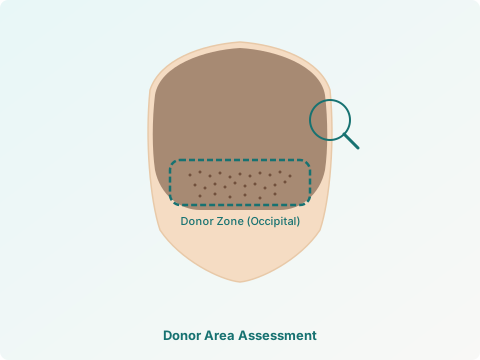
Donor area assessment
The surgeon evaluates donor hair density in the occipital region and designs the recipient hairline pattern based on facial proportions and hair loss grade.
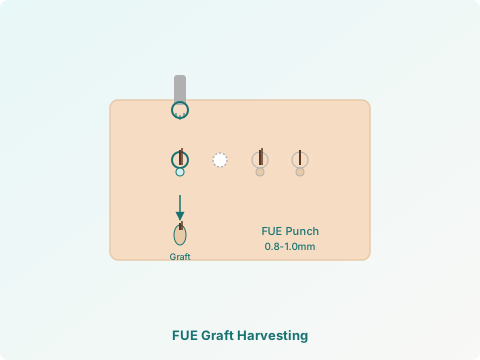
Graft harvesting
For FUE, individual follicular units are extracted one by one with a micro-punch. For FUT, a thin strip of donor scalp is removed and dissected into grafts.
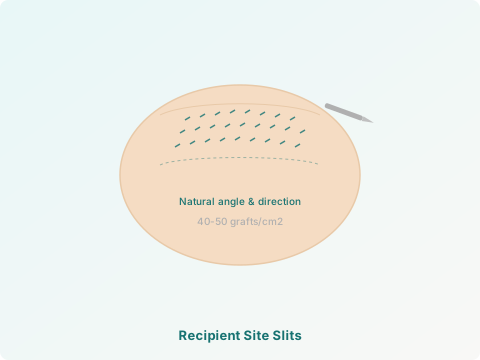
Recipient site creation
Tiny slits are made in the balding area at precise angles and directions matching natural hair growth patterns for a realistic-looking result.
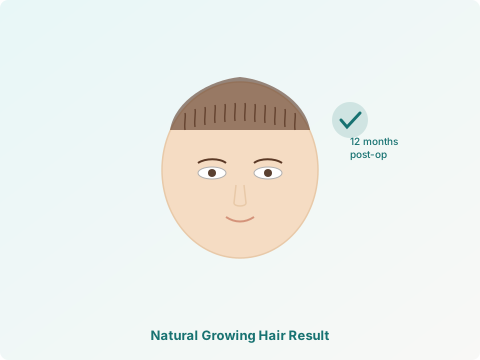
Graft placement
Each follicular unit is carefully inserted into the prepared recipient sites. Grafts begin to shed at 2-4 weeks and regrow permanently from 3-4 months.
Cost · as of 2026
Seoul Medical Insider provides transparent, no-markup pricing for hair transplant procedures in Korea. Your quote clearly breaks down the cost per graft, surgeon's fee, anaesthesia, facility charges, and any add-ons such as PRP therapy or a post-operative hair-care kit.
The main cost driver is graft count — a 2 000-graft FUE session costs significantly less than a 4 000-graft mega-session. FUT is generally less expensive per graft than FUE because harvesting is faster, but FUE avoids a linear scar. Robotic FUE may carry a small premium. Despite world-class results, Korean hair transplant clinics typically charge 40 – 70 % less per graft than clinics in the US, UK, or Australia.
Pricing is reviewed and updated for 2026. Contact us with photos and your goals to receive a personalised graft estimate and quote.
Who it is for
Hair transplantation is highly effective for the right candidates. Consider the following profiles before deciding.
- Suited: Men with Norwood class III – VI androgenetic alopecia who have stable donor density on the back and sides of the scalp.
- Suited: Women with localised thinning (e.g., widening part, temple recession) who have adequate donor reserves and have been evaluated for underlying causes of hair loss.
- Suited: Patients wanting to restore a receding hairline, fill in a thinning crown, or add density to previously transplanted areas.
- Suited: Those willing to commit to a 12 – 18 month timeline for the full result to mature.
- Discuss carefully: Young patients (under 25) whose hair-loss pattern is still progressing — premature transplantation can lead to an unnatural appearance as loss continues.
- Discuss carefully: Patients with diffuse unpatterned alopecia, as the donor area may also be affected and graft survival may be lower.
- Discuss carefully: Those with very limited donor density or advanced Norwood VI – VII loss — available grafts may not cover the area adequately.
Recovery
- Days 1 – 3. Tiny crusts form around each transplanted graft. The donor area may feel tight (FUT) or mildly tender (FUE). Mild forehead swelling can occur and may travel to the brow and eye area by day 3 — this is normal and temporary. Sleep elevated at 45 degrees.
- Days 4 – 10. Crusts begin to loosen with gentle washing (your clinic will provide detailed instructions). Swelling resolves. FUT sutures/staples are removed around day 10 – 14. Most patients feel comfortable returning to non-physical work at day 7.
- Weeks 2 – 6. Transplanted hairs enter a "shedding phase" — this is expected and does not mean grafts have failed. The follicles are alive beneath the surface and will regrow. Light exercise can resume at week 3; avoid direct sun exposure on the scalp.
- Months 3 – 18. New hair growth typically becomes visible around month 3 – 4, with noticeable density by month 6 – 8. Full maturation of thickness and texture continues up to 12 – 18 months.
Plan to stay in Seoul for at least 2 – 3 days after surgery for a post-operative wash and check-up. Many international patients fly home at day 3 – 5 without issues. Seoul Medical Insider can coordinate your appointment schedule and nearby accommodation.
Risks & considerations
Hair transplantation is safe and well-tolerated, but risks include temporary post-operative swelling and bruising, numbness in the donor or recipient area (typically resolves within weeks to months), poor graft survival due to dehydration or trauma during handling, folliculitis (inflamed or ingrown transplanted hairs), infection (rare with proper aftercare), an unnatural-looking hairline if poorly designed, visible scarring in the donor area (linear scar with FUT or dot scars with FUE — especially if shaved short), and shock loss of pre-existing native hairs near the transplant zone (usually temporary). Choosing an experienced surgeon and following post-operative care instructions carefully minimises these risks substantially.
Korea trip checklist
- Send clear photographs of your hairline, crown, and donor area to Seoul Medical Insider for a preliminary assessment and graft estimate before booking.
- Discontinue minoxidil (Rogaine) 1 week before surgery and blood-thinning medications/supplements 2 weeks before, unless otherwise instructed.
- Do not cut or shave your hair before arrival — the surgical team will trim or shave the donor area on the day of surgery as needed.
- Bring a loose-fitting hat or cap for the journey home to protect grafts from sun and dust (avoid tight-fitting hats that press on the recipient area).
- Pack a neck pillow and saline spray bottle — your clinic will advise you to mist the grafts regularly for the first few days.
- Arrange at least 3 days in Seoul post-surgery to attend the first wash and follow-up appointment.
- Ask your clinic for a detailed aftercare guide in English and your surgeon's direct contact for any questions after you return home.
Clinical details are summarized from materials provided by SMI's partner clinics and published guidance from the Korean Society of Plastic and Reconstructive Surgeons (KSPRS). Technique selection is determined by your surgeon during consultation. SMI is a registered patient-facilitation agency, not a medical provider, and does not offer medical advice.
Why get this procedure in Korea
-
Pioneering anti-aging techniques
Korean surgeons are recognised for advanced SMAS and deep-plane techniques that deliver natural, long-lasting results.
-
Comprehensive aftercare
Clinics offer structured recovery programs including LED therapy, lymphatic drainage, and scheduled follow-ups before you fly home.
-
Significant cost advantage
Anti-aging procedures in Korea cost 40-60% less than in Western countries, even at premium clinics with the latest equipment.
You may also consider
Related guides
- How Long Should You Stay in Korea After Plastic Surgery? A logistics hub for international patients — typical recovery-stay windows by procedure, when you can safely fly home, and the visa and interpreter basics for a trip to Seoul.
- The Real All-In Cost of Plastic Surgery in Korea (Beyond the Quote) The surgery quote is only part of the bill. A clear, honest framework for the all-in cost of plastic surgery in Korea — every line item, plus how to avoid hidden fees and the foreigner price gap.
- Is Plastic Surgery in Korea Safe? A Patient's Guide to Avoiding Ghost Surgery A balanced look at safety in Korea's plastic surgery industry — what ghost surgery is, the laws that protect you, and the checks every international patient should make before booking.
Frequently asked questions
Sources
- Ministry of Health and Welfare, Republic of Korea
- Medical Korea (KHIDI)
- Korea Health Industry Development Institute (KHIDI)
- Korean Society of Plastic and Reconstructive Surgeons (KSPRS)
- International Society of Aesthetic Plastic Surgery (ISAPS)
Read our editorial policy to learn how we source and verify information.
