
Procedure guide
Non-Incision Facelift in Korea
- Surgery time Around 1 – 1.5 hours
- Anesthesia type Local anesthesia with sleeping sedation
- Hospitalization Not required
- Face wash & makeup 3 days after surgery
- Post-surgery check-up 1 time (depending on the patient's condition)
- Stitches removal Not required



A non-incision facelift — most commonly performed as a thread lift — tightens and lifts sagging facial skin without the scalpels and extended downtime of a surgical facelift. Using absorbable barbed threads inserted beneath the skin through tiny needle punctures, Korean surgeons can elevate the jawline, mid-face, and brow in a single lunchtime-length session. South Korea pioneered many of the PDO, PLLA, and PCL thread technologies now used worldwide, and Seoul clinics offer some of the most advanced thread-lift protocols available.
The procedure is ideal for patients who notice early to moderate facial sagging but are not ready — or do not need — a full surgical lift. Results are visible immediately, improve over the following months as the threads stimulate collagen production, and typically last 1 – 3 years depending on the thread type.
| Procedure time | 30 – 60 minutes |
| Anaesthesia | Local anaesthesia (topical + infiltration) |
| Hospital stay | None — outpatient |
| Back to routine | 2 – 5 days |
| Final result | 2 – 3 months (collagen remodelling) |
This page is for informational purposes only and does not replace a professional medical consultation. Individual results vary depending on anatomy, health status, and treatment plan.
How it works
Thread lifts work by mechanically repositioning tissue and then triggering a controlled healing response that builds new collagen around each thread. Here is the typical step-by-step process.
- Planning. The surgeon marks lifting vectors on the face while you are seated upright. The number of threads, type (PDO, PLLA, or PCL), and insertion points are decided based on the degree of laxity and desired lift.
- Anaesthesia. Topical numbing cream is applied for 20 – 30 minutes, followed by targeted local anaesthetic injections at each entry point. Patients remain awake and comfortable throughout.
- Access. A thin cannula or needle creates entry points — usually at the temples, hairline, or in front of the ear. No incisions are made; the puncture sites are 1 – 2 mm.
- Thread placement. Barbed or cogged threads are guided beneath the skin along the pre-marked vectors. Once positioned, the threads are gently pulled to lift tissue, and the barbs anchor into the subcutaneous layer to hold the new position.
- Finishing. Excess thread is trimmed, entry points are covered with small adhesive strips, and a light compression band may be worn for the first night. No stitches are required.
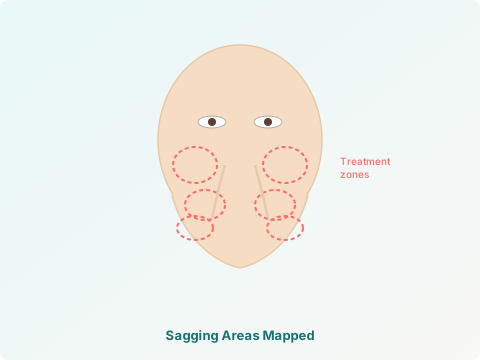
Treatment mapping
The surgeon marks the areas of sagging and plans thread insertion points and energy device application zones based on the desired lifting effect.
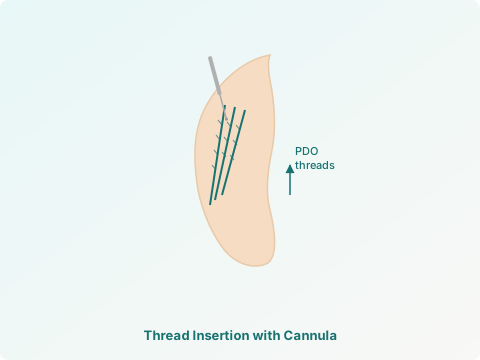
Thread insertion
Absorbable barbed threads (PDO, PLLA, or PCL) are inserted under the skin using thin needles, creating a scaffold that lifts sagging tissue upward.
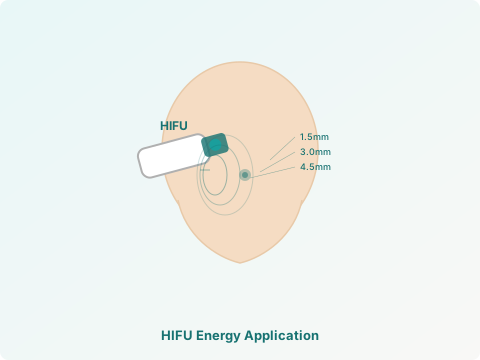
Energy device application
HIFU (high-intensity focused ultrasound) or radiofrequency energy is applied to stimulate deep collagen contraction, enhancing the thread lift effect.
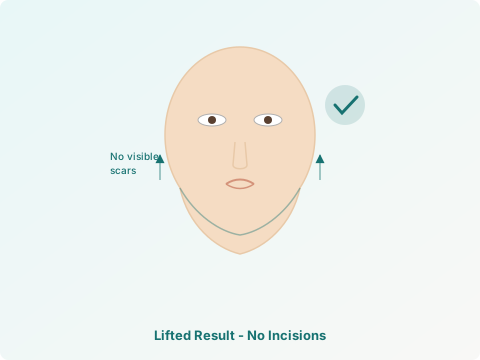
Immediate results
Lifting is visible immediately. Results continue to improve over 2-3 months as collagen remodels around the threads. No suture removal is needed.
Cost · as of 2026
Seoul Medical Insider arranges non-incision facelift treatments at transparent, no-markup pricing. Your quote will detail the thread type, number of threads, and any add-on treatments (e.g., skin boosters or HIFU) so you know exactly what you are paying for.
Cost depends primarily on the number and type of threads used. A basic PDO thread lift for the jawline may require 10 – 20 threads, while a full-face treatment combining lifting threads with fine mono threads for skin tightening can use 40 – 80 threads. PLLA and PCL threads, which stimulate longer-lasting collagen formation, are priced higher per thread than standard PDO. Even so, prices in Korea are typically 50 – 70 % lower than comparable treatments in Western countries.
All pricing is reviewed and updated for 2026. Request a personalised quote to compare options.
Who it is for
Thread lifts bridge the gap between non-invasive skin tightening (like HIFU or RF) and a surgical facelift. Understanding who benefits most will help you decide.
- Suited: Adults aged 30 – 55 with mild to moderate sagging of the cheeks, jawline, or brow who want visible improvement without surgery.
- Suited: Patients looking for a quick procedure with minimal downtime — ideal for those who cannot take extended leave from work.
- Suited: Those who want to "test" the effect of a lift before committing to surgical options in the future.
- Suited: Patients combining threads with skin boosters, Botox, or filler for a comprehensive non-surgical rejuvenation plan.
- Discuss carefully: Patients with significant skin laxity or heavy jowling — a surgical facelift will deliver a more dramatic and longer-lasting result.
- Discuss carefully: Those with very thin skin, as threads may be palpable or visible beneath the surface.
- Discuss carefully: Patients prone to keloid or hypertrophic scarring, as the foreign-body response may be unpredictable.
Recovery
- Days 1 – 3. Mild swelling, tenderness, and a slight pulling sensation are normal. Bruising at entry points is minimal for most patients. Sleep on your back with your head elevated. Avoid wide mouth opening, vigorous chewing, and facial massage.
- Days 4 – 7. Swelling subsides and the lifting effect becomes more apparent. Most patients return to work and social activities. Small adhesive strips over entry points can be removed or concealed with make-up.
- Weeks 2 – 4. Any residual firmness or mild asymmetry settles. You may resume light exercise at week 2 and moderate exercise at week 3. Avoid saunas, steam rooms, and intense heat.
- Months 2 – 6. Collagen remodelling around the threads provides additional tightening beyond the initial mechanical lift. Skin texture and firmness continue to improve.
Because downtime is short, many international patients combine a thread lift with a few days of sightseeing in Seoul. Plan to stay at least 3 – 5 days after treatment so your doctor can check the result and address any concerns before you fly home.
Risks & considerations
Thread lifts are minimally invasive but not risk-free. Possible complications include bruising at entry points, infection (rare with proper technique), thread migration or extrusion through the skin, dimpling or puckering of the skin surface, asymmetry, palpable threads beneath thin skin, and temporary numbness or tingling. In rare cases a thread may irritate tissue and require removal. Allergic reactions to thread materials are uncommon but possible. An experienced practitioner who uses quality threads and sterile technique significantly reduces these risks.
Korea trip checklist
- Schedule a video consultation through Seoul Medical Insider to discuss your goals, skin type, and the most suitable thread type.
- Stop blood-thinning supplements (fish oil, vitamin E, ginkgo biloba) and medications (aspirin, ibuprofen) at least 1 week before treatment.
- Plan accommodation in Seoul for at least 3 – 5 days after the procedure for a follow-up check.
- Bring a wide, soft scarf or gentle compression band for the first night; your clinic may also provide one.
- Stock up on soft foods — soups, smoothies, and yoghurt — as chewing can be uncomfortable for the first 2 – 3 days.
- Avoid scheduling dental work for at least 4 weeks after a thread lift, as wide mouth opening can displace threads.
- Keep your surgeon's contact details and a treatment summary in English for follow-up care at home.
Clinical details are summarized from materials provided by SMI's partner clinics and published guidance from the Korean Society of Plastic and Reconstructive Surgeons (KSPRS). Technique selection is determined by your surgeon during consultation. SMI is a registered patient-facilitation agency, not a medical provider, and does not offer medical advice.
Why get this procedure in Korea
-
Pioneering anti-aging techniques
Korean surgeons are recognised for advanced SMAS and deep-plane techniques that deliver natural, long-lasting results.
-
Comprehensive aftercare
Clinics offer structured recovery programs including LED therapy, lymphatic drainage, and scheduled follow-ups before you fly home.
-
Significant cost advantage
Anti-aging procedures in Korea cost 40-60% less than in Western countries, even at premium clinics with the latest equipment.
You may also consider
Related guides
- Thermage vs Ultherapy in Korea: Cost and Which to Pick Thermage and Ultherapy do different jobs. A clear guide to RF vs ultrasound lifting in Korea — what each does, how pricing and shot counts work, the Korean HIFU alternatives, and how to confirm a genuine device.
- Thread Lift in Korea: Cost, Results, and Who It's Really For What a thread lift in Korea can and can't do — thread types, typical cost and downtime, how long results last, and the honest line where a surgical lift makes more sense.
- Fat Grafting in Korea: What International Patients Should Know About Fat Transfer Procedures Korea has become a leading destination for fat grafting procedures, from facial rejuvenation to breast and body contouring. This guide covers what international patients need to know about techniques, costs, recovery, and choosing a qualified surgeon.
- The Real All-In Cost of Plastic Surgery in Korea (Beyond the Quote) The surgery quote is only part of the bill. A clear, honest framework for the all-in cost of plastic surgery in Korea — every line item, plus how to avoid hidden fees and the foreigner price gap.
Frequently asked questions
Sources
- Ministry of Health and Welfare, Republic of Korea
- Medical Korea (KHIDI)
- Korea Health Industry Development Institute (KHIDI)
- Korean Society of Plastic and Reconstructive Surgeons (KSPRS)
- International Society of Aesthetic Plastic Surgery (ISAPS)
Read our editorial policy to learn how we source and verify information.
