
Procedure guide
Protruding Mouth Surgery in Korea
- Surgery time Around 1 – 2 hours
- Anesthesia type General anesthesia
- Hospitalization 1 night
- Face wash & makeup 3 days after surgery
- Post-surgery check-up 2 times (depending on the patient's condition)
- Stitches removal 14 days after surgery


Protruding mouth surgery — known medically as anterior segmental osteotomy (ASO) — corrects a mouth that projects forward relative to the rest of the face. This bimaxillary protrusion is common across many ethnicities and creates a profile where the lips and the underlying bone between the nose and chin appear to push outward. Unlike orthodontics alone, ASO repositions the bone itself, producing a more immediate and dramatic profile change.
Korea has become a leading destination for this procedure because of its high case volume, refined surgical protocols, and the integration of orthodontic and surgical planning under one roof. International patients benefit from experienced surgical teams accustomed to treating diverse facial structures.
| Surgery time | 1.5 – 2.5 hours |
|---|---|
| Anaesthesia | General anaesthesia |
| Hospital stay | 1 night |
| Back to routine | 2 – 3 weeks |
| Final result | 3 – 6 months (longer if combined with orthodontics) |
The information on this page is for educational purposes and does not replace a professional medical consultation. Individual anatomy, health status, and surgical goals vary — always consult a qualified surgeon before making decisions.
How it works
Protruding mouth surgery works by moving the front segment of the upper jaw (maxilla) and often the lower jaw (mandible) backward. To create space for this movement, the first premolars on each side are typically extracted weeks before surgery. The bone between the extraction sites is then cut, and the front teeth and their supporting bone are repositioned as a single block.
- Planning — Cephalometric X-rays, 3-D CT scans, and dental models are analysed to determine how many millimetres the anterior segment must move back. If orthodontics is needed to align the teeth before or after surgery, that plan is coordinated in advance. Premolar extractions are performed 4 – 8 weeks prior to surgery.
- Anaesthesia — General anaesthesia is administered. Nasotracheal intubation is standard to provide clear surgical access to the mouth.
- Access — Incisions are made inside the mouth along the upper and/or lower gum line. The mucoperiosteal flap is elevated to expose the bone in the premolar extraction area.
- Reshaping — Using a precision saw and osteotomes, the surgeon cuts the bone vertically at the extraction sites and horizontally above the tooth roots (in the maxilla, below the nasal floor). The freed anterior segment is moved posteriorly by the planned amount, then fixed in place with titanium mini-plates and screws. The same process is repeated on the lower jaw if a bimaxillary correction is needed.
- Closing — The gum tissue is sutured with absorbable stitches. A light splint or elastics may be placed to guide the bite during initial healing.
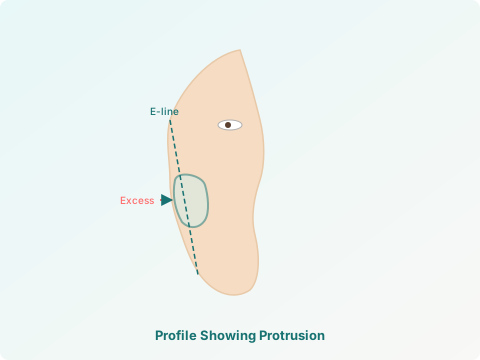
Cephalometric analysis
Lateral cephalogram and 3D CT determine the degree of dental and skeletal protrusion. Orthodontic coordination may be planned for pre- or post-surgical alignment.
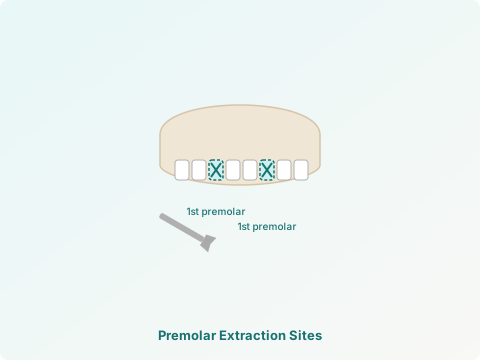
Premolar extraction space
If not already extracted during pre-surgical orthodontics, first premolars are removed to create the space needed to retract the protruding anterior segment.
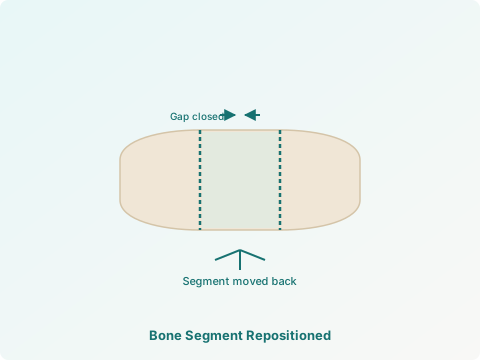
Anterior segmental osteotomy
The anterior alveolar bone segment is cut and moved backward into the extraction space, reducing the protrusion of both the teeth and surrounding bone.
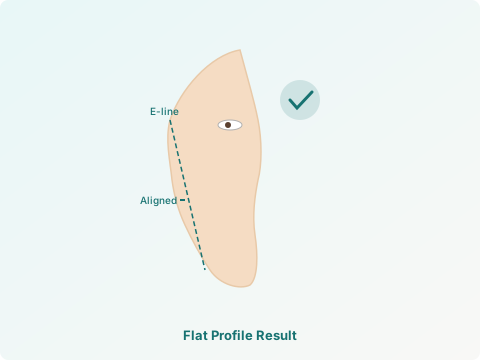
Fixation & soft tissue adaptation
Titanium plates secure the repositioned segment. The lips naturally retract as the underlying skeletal support changes, improving the overall profile.
Cost · as of 2026
Seoul Medical Insider provides straightforward pricing with no agency surcharges. We share the clinic's direct quote so you can make informed decisions without worrying about hidden costs.
Protruding mouth surgery in Korea typically costs between KRW 5,000,000 and KRW 10,000,000 (approximately USD 3,800 – 7,500). The price depends on whether one jaw or both jaws are treated, the complexity of the bone cuts, and whether pre-surgical orthodontic alignment is included. Premolar extraction fees are usually separate and modest. Combined packages with rhinoplasty or chin surgery are available at many clinics and may reduce the overall per-procedure cost.
All pricing information is reviewed and updated as of 2026. Reach out to Seoul Medical Insider for a detailed quotation tailored to your imaging results.
Who it is for
Protruding mouth surgery addresses a specific skeletal issue — forward projection of the tooth-bearing bone — and is best suited for patients whose protrusion is dental-skeletal rather than purely dental.
- Suited: Adults with bimaxillary protrusion — both upper and lower jaw segments project forward, creating a convex profile and lip incompetence (difficulty closing the lips at rest).
- Suited: Patients who have already tried orthodontics alone without achieving a satisfactory profile change.
- Suited: Individuals whose premolars have already been extracted for orthodontic treatment, providing the space needed for segmental setback.
- Discuss carefully: Patients with active periodontal (gum) disease — bone healing around the osteotomy may be compromised.
- Discuss carefully: Those with a very short chin, as retracting the anterior segment may make the chin appear even more recessed; a genioplasty may be recommended simultaneously.
- Discuss carefully: Patients who are unwilling to lose premolars — the extractions are almost always necessary to create space for bone movement.
Recovery
- Week 1 — Moderate to significant swelling concentrated around the mouth and upper lip. Lips may feel stiff and numb. Diet is strictly liquid. Pain is managed with prescribed analgesics. A nasal drip or mild nosebleed is normal if the maxillary floor was osteotomised.
- Weeks 2 – 3 — Swelling decreases substantially. Patients transition to soft foods (porridge, scrambled eggs, well-cooked noodles). Lip numbness begins to improve. Oral hygiene with a soft brush and antiseptic rinse is critical to prevent infection at the incision sites.
- Weeks 4 – 8 — Most visible swelling is resolved. Bone union is progressing; patients can gradually reintroduce firmer foods. Light exercise is permitted. If post-surgical orthodontics is planned, bracket adjustments may begin around week 6.
- Months 3 – 12 — Full bone consolidation and soft-tissue adaptation. The profile settles into its final shape. Upper-lip sensation usually returns fully within 6 – 12 months.
International patients should budget at least 10 – 14 days in Seoul. The first week requires close monitoring, and a follow-up X-ray at 7 – 10 days confirms bone position before you are cleared to travel.
Risks & considerations
Protruding mouth surgery carries risks that are specific to segmental osteotomy of the tooth-bearing bone. These include temporary or prolonged numbness of the upper lip, lower lip, or chin due to irritation of the infraorbital or mental nerves; devitalisation (loss of vitality) of teeth adjacent to the osteotomy line, potentially requiring root canal treatment later; infection at the bone-cut site or around fixation hardware; non-union or delayed union of the bone segments; relapse of the anterior segment forward if fixation is insufficient or post-surgical orthodontic compliance is poor; nasal floor changes that may slightly widen the nostrils or alter nasal airflow; gum recession around the teeth near the extraction sites; and asymmetric setback resulting in a midline shift. Careful pre-operative planning with 3-D imaging and coordination between surgeon and orthodontist greatly minimise these risks.
Korea trip checklist
- Complete premolar extractions at home 4 – 8 weeks before your scheduled surgery date in Korea, unless your surgeon prefers to do them in-clinic.
- Bring all dental records, panoramic X-rays, and cephalometric films — digital formats are preferred for surgical planning software.
- Discuss orthodontic coordination: if you wear braces, confirm whether your home orthodontist and Korean surgeon can collaborate on bracket adjustments.
- Prepare a liquid-diet supply for the first week — portable blenders, protein shakes, and electrolyte drinks are helpful.
- Pack lip balm and a saline nasal spray; both the lips and nasal passages tend to dry out after surgery.
- Plan a 10 – 14 day stay in Seoul to allow for the post-operative X-ray and clearance appointment before flying.
- Confirm travel insurance coverage for elective oral surgery complications, including potential dental follow-up at home.
Clinical details are summarized from materials provided by SMI's partner clinics and published guidance from the Korean Society of Plastic and Reconstructive Surgeons (KSPRS). Technique selection is determined by your surgeon during consultation. SMI is a registered patient-facilitation agency, not a medical provider, and does not offer medical advice.
Why get this procedure in Korea
-
World-leading surgical volume
Korean plastic surgeons perform more facial procedures per capita than any other country, refining techniques through high case volumes.
-
Board-certified specialists
All SMI partner surgeons hold Korean Board of Plastic Surgery certification and operate at JCI or KOIHA-accredited facilities.
-
40-60% cost savings
Comparable or superior results at a fraction of US/EU pricing, with no compromise on safety standards or technology.
You may also consider
Related guides
- Two-Jaw Surgery in Korea: What International Patients Need to Know Two-jaw surgery corrects functional and aesthetic jaw misalignment by repositioning both the upper and lower jaw. Korea has become a leading destination for this complex procedure — here's what international patients should know before committing.
- Chin Surgery in Korea: A Complete Guide to Genioplasty for International Patients Considering genioplasty in Korea? Costs, surgeon selection, recovery, and what international patients should expect at Seoul's top chin surgery clinics.
- How Long Should You Stay in Korea After Plastic Surgery? A logistics hub for international patients — typical recovery-stay windows by procedure, when you can safely fly home, and the visa and interpreter basics for a trip to Seoul.
- The Real All-In Cost of Plastic Surgery in Korea (Beyond the Quote) The surgery quote is only part of the bill. A clear, honest framework for the all-in cost of plastic surgery in Korea — every line item, plus how to avoid hidden fees and the foreigner price gap.
Frequently asked questions
Sources
- Ministry of Health and Welfare, Republic of Korea
- Medical Korea (KHIDI)
- Korea Health Industry Development Institute (KHIDI)
- Korean Society of Plastic and Reconstructive Surgeons (KSPRS)
- International Society of Aesthetic Plastic Surgery (ISAPS)
Read our editorial policy to learn how we source and verify information.
