
Procedure guide
Tip Plasty (Nasal Tip Surgery) in Korea
- Surgery time Around 0.5 – 1 hour
- Anesthesia type Local anesthesia with sleeping sedation
- Hospitalization Not required
- Face wash & makeup 5 – 7 days after surgery
- Post-surgery check-up 1 time (depending on the patient's condition)
- Stitches removal 5 – 7 days after surgery



Tip plasty, also called nasal tip surgery or nasal tip refinement, is a rhinoplasty procedure focused exclusively on reshaping the tip of the nose. It addresses concerns such as a bulbous, wide, droopy, upturned, or asymmetric nasal tip without altering the nasal bridge. For patients whose bridge already looks balanced, tip plasty delivers a significant aesthetic improvement through a more targeted operation.
Korean plastic surgeons are internationally recognised for tip plasty expertise. The procedure requires a deep understanding of lower lateral cartilage anatomy, tip support mechanisms, and skin thickness — all of which vary significantly between ethnicities. Korean surgeons routinely work with both Asian patients (who often have thicker tip skin and weaker cartilage) and international patients seeking natural-looking refinement, making them versatile tip plasty specialists.
At a glance | |
Surgery time | 60 – 90 minutes |
|---|---|
Anaesthesia | Local with sedation or general |
Hospital stay | Outpatient — discharged same day |
Back to routine | 5 – 7 days |
Final result | 6 – 12 months (tip swelling resolves slowly) |
This page is for informational purposes. Individual results vary. A board-certified surgeon should evaluate your anatomy before any procedure.
How it works
Tip plasty reshapes the nasal tip by modifying the lower lateral (alar) cartilages and, when needed, adding structural cartilage grafts for support and definition.
- Planning — The surgeon analyses the tip shape from front, profile, and base views. Key measurements include tip projection (how far it protrudes from the face), tip rotation (the angle between the upper lip and the columella), and tip width (the distance between the tip-defining points). The surgical strategy — suture refinement, cartilage trimming, grafting, or a combination — is determined.
- Anaesthesia — Local anaesthetic with sedation or general anaesthesia is administered depending on the complexity and patient preference.
- Access — An open approach (trans-columellar incision connecting bilateral intra-nasal incisions) provides direct visualisation of the tip cartilages. For simpler refinements, a closed (endonasal) approach may suffice.
- Cartilage reshaping — The lower lateral cartilages are exposed and reshaped. Techniques include cephalic trim (removing the upper edge of the cartilage to narrow the tip), inter-domal sutures (bringing the two cartilage domes closer together for a more refined point), columellar strut grafts (a cartilage strut placed between the medial crura for tip support), and shield or onlay grafts (cartilage placed at the tip to increase projection or definition). Donor cartilage is typically harvested from the nasal septum; if insufficient, ear cartilage is used.
- Closing — Incisions are closed with fine sutures. Nasal tip taping or a small splint is applied to compress the skin and support the new tip shape during healing.
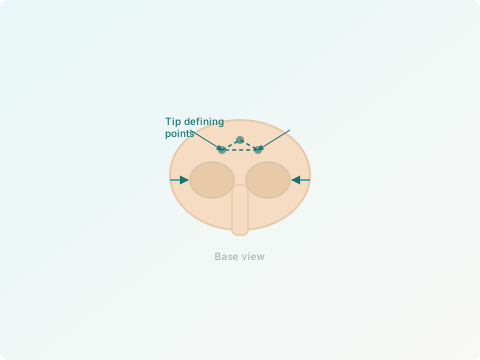
Tip assessment
The surgeon evaluates the lower lateral cartilages, tip projection, rotation, and skin thickness to determine the optimal reshaping strategy.
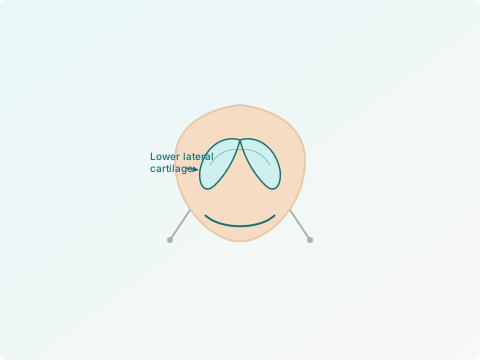
Cartilage exposure
Through an open (columellar) or endonasal approach, the tip cartilages are fully exposed for precise visualization and manipulation.
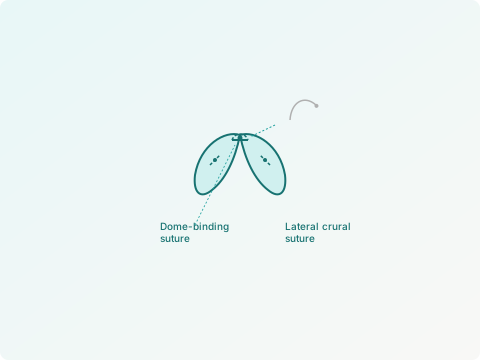
Tip refinement
The surgeon uses suture techniques, cartilage trimming, or septal cartilage grafts to reshape, project, or rotate the nasal tip to the planned position.
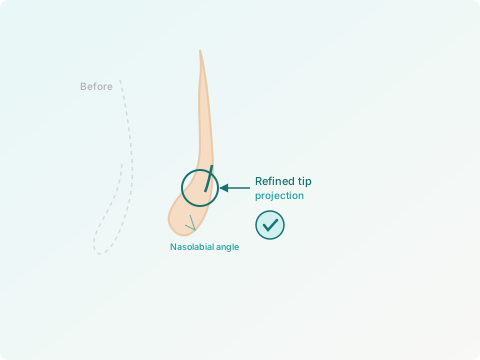
Closure & taping
Incisions are closed with fine sutures. Nasal tip tape and a light splint support the new tip shape during the initial healing phase.
Cost · as of 2026
Through Seoul Medical Insider, tip plasty in Korea is priced transparently. The quote covers the surgeon's fee, anaesthesia, operating facility, post-operative taping and splint, and all follow-up appointments. There are no hidden charges or agency markups.
The cost varies depending on the complexity of the tip reshaping, whether cartilage grafting is required (and the donor site — septal cartilage is simpler than ear cartilage harvest), whether tip plasty is performed alone or combined with bridge work, and whether the case is primary or revision. Revision tip plasty is more complex due to scar tissue and potentially compromised cartilage from prior surgery.
All pricing is reviewed and confirmed as of 2026. Send front, profile, and base-view photos through our consultation form for a personalised quote.
Who it is for
Tip plasty is ideal for patients whose primary concern is the shape of the nasal tip rather than the bridge.
- Suited for: Patients with a bulbous or round nasal tip who want a more refined, narrower tip point.
- Suited for: Patients with a droopy tip that dips downward when smiling, making the nose appear longer.
- Suited for: Patients with a flat, under-projected tip who want more definition and a subtle increase in tip height without altering the bridge.
- Suited for: Patients with tip asymmetry — one side higher or wider than the other.
- Discuss carefully: Patients with very thick nasal tip skin — the skin may not conform to the reshaped cartilage framework, limiting the visible refinement. The surgeon may recommend adjunctive skin thinning techniques.
- Discuss carefully: Patients who also want bridge changes — in that case a full rhinoplasty (bridge + tip) is more appropriate than isolated tip plasty.
Recovery
- Week 1: A small splint or tape dressing covers the nasal tip for 5 – 7 days. Mild swelling and possible bruising around the nose (less bruising than rhinoplasty with osteotomy). The tip feels stiff and numb. Avoid any pressure on the tip. Sleep on your back with the head elevated.
- Weeks 2 – 3: The splint or tape is removed. The tip appears swollen and rounded — this is normal and does not reflect the final shape. Light daily activities resume. Avoid blowing the nose forcefully. External sutures at the columella are removed around day 7 if the open approach was used.
- Weeks 4 – 8: Tip swelling gradually decreases. The refined shape starts to become visible. Light exercise can resume from week 4. The tip may still feel firm when pressed.
- Months 3 – 12: The nasal tip is the slowest area of the nose to reach its final shape because the thick tip skin takes many months to fully contract around the cartilage framework. Patients with thicker skin should expect the refinement to continue improving for up to a full year.
Plan to stay in Korea for at least 7 – 10 days. Splint or tape removal (day 5 – 7) and suture removal (day 7, open approach) require in-person visits. A follow-up assessment of tip shape is recommended before departing.
Risks & considerations
Tip plasty is generally safe but involves cartilage work in a highly visible area. Possible complications include asymmetric tip shape, over-narrowing creating a pinched appearance, under-correction with insufficient tip definition, cartilage graft visibility or palpability through thin skin, bossae (small cartilage projections visible under the skin), loss of tip support causing the tip to droop over time if structural grafts are insufficient, columellar scar (open approach) that is slow to mature, numbness at the nasal tip lasting weeks to months, and rarely, infection or graft displacement. Choosing a surgeon who specialises in tip refinement and uses structural grafting principles minimises the risk of long-term tip drooping or collapse.
Korea trip checklist
- Submit front-view, profile, base-view (looking up), and three-quarter photos during your consultation — tip shape is assessed from multiple angles.
- Stop aspirin, ibuprofen, vitamin E, omega-3, and herbal supplements at least 7 days before surgery.
- If you have had prior nose surgery or filler injections in the nose, disclose this during the consultation — it affects the surgical approach and cartilage availability.
- Bring a travel-size saline nasal spray for gentle nasal hygiene after surgery.
- Arrange accommodation near the clinic for the first 7 – 10 days to attend splint/tape removal and follow-up appointments.
- Avoid tight-fitting sunglasses, nose pads, or anything that rests on or presses the nasal tip for at least 4 weeks.
- Be patient with the final result — tip swelling resolves over many months, and the refined shape reveals itself gradually.
Clinical details are summarized from materials provided by SMI's partner clinics and published guidance from the Korean Society of Plastic and Reconstructive Surgeons (KSPRS). Technique selection is determined by your surgeon during consultation. SMI is a registered patient-facilitation agency, not a medical provider, and does not offer medical advice.
Why get this procedure in Korea
-
World-leading surgical volume
Korean plastic surgeons perform more facial procedures per capita than any other country, refining techniques through high case volumes.
-
Board-certified specialists
All SMI partner surgeons hold Korean Board of Plastic Surgery certification and operate at JCI or KOIHA-accredited facilities.
-
40-60% cost savings
Comparable or superior results at a fraction of US/EU pricing, with no compromise on safety standards or technology.
You may also consider
Related guides
- Rhinoplasty in Korea: The International Patient’s Cost & Surgery Guide A clear, educational guide to rhinoplasty in Korea for foreigners — procedure types, what drives cost, recovery, and how to choose a surgeon safely.
- Rhinoplasty Recovery in Korea: A Week-by-Week Aftercare Guide for International Patients Planning rhinoplasty in Korea? This guide walks you through the full recovery timeline—from the first 48 hours to final results—with practical aftercare tips tailored to international patients.
- Rhinoplasty Recovery in Korea Week by Week: Swelling Timeline, Splint Care, and What International Patients Should Expect A detailed week-by-week guide to rhinoplasty recovery in Korea, covering swelling progression, splint and stitch removal, aftercare for international patients, and when you can expect your final results to appear.
- The Real All-In Cost of Plastic Surgery in Korea (Beyond the Quote) The surgery quote is only part of the bill. A clear, honest framework for the all-in cost of plastic surgery in Korea — every line item, plus how to avoid hidden fees and the foreigner price gap.
Frequently asked questions
Sources
- Ministry of Health and Welfare, Republic of Korea
- Medical Korea (KHIDI)
- Korea Health Industry Development Institute (KHIDI)
- Korean Society of Plastic and Reconstructive Surgeons (KSPRS)
- International Society of Aesthetic Plastic Surgery (ISAPS)
Read our editorial policy to learn how we source and verify information.
