
Procedure guide
Hump Nose Reduction in Korea
- Surgery time Around 1 hour
- Anesthesia type Local anesthesia with sleeping sedation
- Hospitalization Not required
- Face wash & makeup 7 days after surgery
- Post-surgery check-up 1 time (depending on the patient's condition)
- Stitches removal 7 days after surgery



Hump nose reduction is a rhinoplasty procedure that removes or reduces the visible bump on the nasal bridge — the dorsal hump. This hump is formed by a combination of excess bone in the upper third and excess cartilage in the middle third of the nose. Reducing it creates a smoother, straighter profile that balances the face more harmoniously.
Korean rhinoplasty surgeons are experienced in hump reduction for a diverse range of nasal anatomies. Many international patients travel to Korea specifically because Korean surgeons excel at achieving a natural, refined profile line rather than an overly scooped or "ski-slope" nose. The emphasis is on proportional reduction — lowering the hump just enough to create a smooth dorsal line without making the nose look operated on.
At a glance | |
Surgery time | 60 – 120 minutes (varies if combined with tip work) |
|---|---|
Anaesthesia | General or deep sedation |
Hospital stay | Outpatient or one night |
Back to routine | 7 – 10 days (splint removal) |
Final result | 6 – 12 months |
This page is for informational purposes. Individual results vary. A board-certified surgeon should evaluate your anatomy before any procedure.
How it works
Hump reduction reshapes the bony and cartilaginous dorsum to create a straight or gently curved profile. The approach depends on the hump size and the patient's overall rhinoplasty goals.
- Planning — The surgeon analyses the dorsal hump in profile view, measuring the height of the excess bone and cartilage. Computer imaging may be used to show the expected profile change. The surgical plan addresses whether the hump is primarily bony, cartilaginous, or both.
- Anaesthesia — General anaesthesia or deep IV sedation is administered. The nasal lining is decongested and locally infiltrated with anaesthetic for haemostasis.
- Access — An open approach (small incision at the columella plus internal incisions) or a closed approach (entirely internal incisions) is chosen based on the complexity. If tip refinement or osteotomy is planned simultaneously, the open approach provides better visibility.
- Hump removal — The bony hump is reduced with a rasp or osteotome. The cartilaginous component of the dorsal septum and upper lateral cartilages is trimmed with a scalpel. After hump removal, the nasal dorsum may appear flat or have an "open roof" — the bony sidewalls no longer meet in the midline.
- Closing the open roof (osteotomies) — Lateral osteotomies are performed to narrow the nasal bones inward, closing the open roof and restoring a smooth, narrow dorsal line. Spreader grafts may be placed to maintain the internal nasal valve and prevent breathing obstruction.
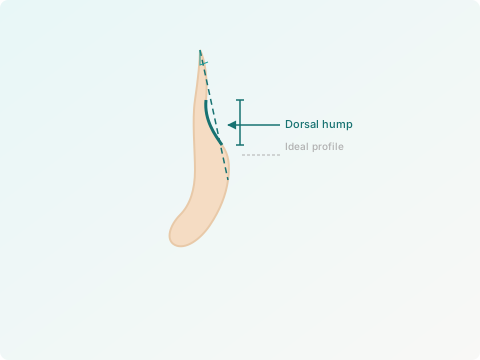
Hump analysis & planning
The surgeon uses lateral X-ray and 3D imaging to measure the bony and cartilaginous components of the dorsal hump and plan the reduction amount.
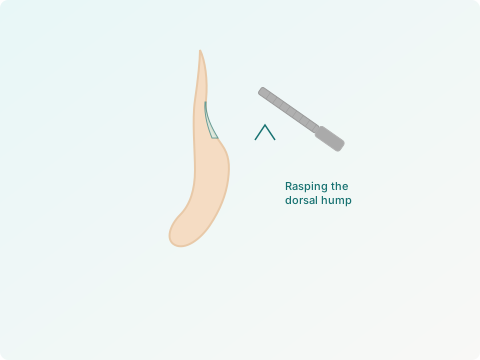
Cartilage & bone rasping
Through an open or closed rhinoplasty approach, the cartilaginous upper portion of the hump is trimmed with a scalpel and the bony portion is filed with a rasp.
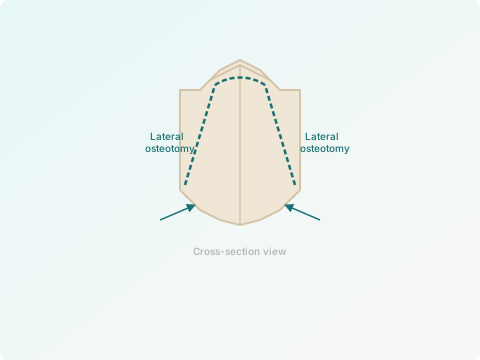
Open roof closure
After hump removal, the nasal bones may form an "open roof." Controlled osteotomies narrow the bones inward to close this gap and restore a smooth dorsum.
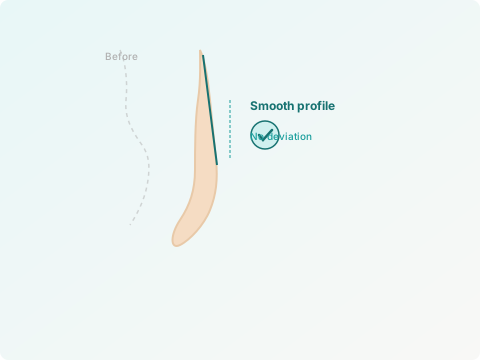
Splinting & recovery
A nasal splint is applied to maintain the new dorsal line. Taping supports soft tissue contraction over the reshaped bone and cartilage framework.
Cost · as of 2026
Through Seoul Medical Insider, hump nose reduction in Korea is quoted with full transparency. The price includes the surgeon's fee, anaesthesia, facility charges, splint and cast materials, and all standard follow-up visits. No intermediary markup is applied.
Cost varies depending on the severity of the hump, whether osteotomies (bone cuts to narrow the bridge after hump removal) are needed, whether tip plasty or septoplasty is combined, and whether the case is a primary rhinoplasty or a revision. Revision hump cases involve scar tissue and potentially prior implant removal, increasing complexity and cost.
All pricing is reviewed and confirmed as of 2026. Share your profile and front-view photos through our consultation form for a personalised quote.
Who it is for
Hump reduction is one of the most commonly requested rhinoplasty goals worldwide. It suits a wide range of patients.
- Suited for: Patients with a visible bump on the nasal bridge — whether prominent or subtle — who desire a straighter or smoother profile.
- Suited for: Patients whose dorsal hump creates an imbalanced side profile, making the nose appear disproportionately large relative to the chin and forehead.
- Suited for: Patients who want comprehensive rhinoplasty (bridge + tip) — hump reduction is often part of a full rhinoplasty plan rather than a standalone procedure.
- Discuss carefully: Patients with very thick nasal skin — the skin may not re-drape tightly over a reduced dorsum, potentially masking the improvement or creating contour irregularities.
- Discuss carefully: Patients with a history of nasal trauma or previous rhinoplasty — the bone and cartilage may be irregular, requiring more complex reconstruction rather than simple rasping.
Recovery
- Week 1: A nasal splint and external cast are worn for 5 – 7 days. Expect bruising under both eyes (especially if osteotomies were performed) and significant swelling around the bridge and mid-face. Breathing through the nose is partially obstructed by internal swelling and possible internal splints. Sleep with the head elevated at 30 – 45 degrees.
- Weeks 2 – 3: The splint is removed at 7 days, revealing the new profile — though swelling still obscures the final shape. Bruising fades. Social activities can gradually resume with concealer if needed. Avoid glasses resting on the bridge for 4 – 6 weeks.
- Weeks 4 – 8: Most visible swelling resolves. The dorsal line looks progressively smoother and more defined. Nasal breathing improves as internal swelling subsides. Light exercise may resume from week 4.
- Months 3 – 12: Residual swelling in the supratip area (just above the nasal tip) resolves slowly. The final profile and nasal width are fully apparent by 9 – 12 months for thicker-skinned patients, and by 6 months for thinner-skinned patients.
International patients should plan a minimum 10-day stay in Korea. The splint removal appointment at day 7 is essential, and the surgeon typically wants a follow-up on day 10 to assess the early healing of the bone work. Contact sports and impact activities should be avoided for 3 months.
Risks & considerations
Hump reduction is a well-established rhinoplasty technique, but involves bone and cartilage work with inherent risks. Possible complications include an irregular dorsal contour (small bumps or asymmetries visible under thin skin), over-reduction creating a scooped or saddled profile, under-reduction leaving a residual hump, open-roof deformity if osteotomies are incomplete, internal nasal valve collapse causing breathing difficulty (prevented by spreader grafts), prolonged swelling of the supratip, asymmetric nasal bones after osteotomies, numbness at the nasal tip that usually resolves over months, post-operative bleeding, and rarely, infection. Revision rates for rhinoplasty in general are 5 – 15%, and choosing a high-volume Korean rhinoplasty surgeon reduces this risk substantially.
Korea trip checklist
- Provide clear profile photos (left side, right side, and three-quarter view) during your online consultation — the dorsal hump is best assessed from the side.
- Stop aspirin, ibuprofen, vitamin E, omega-3, and herbal supplements (ginseng, ginkgo) at least 10 days before surgery. These increase bleeding risk during bone work.
- If you wear glasses, bring contact lenses or prepare a glasses strap that rests on the forehead — you must not rest frames on the nasal bridge for 4 – 6 weeks after surgery.
- Pack a travel humidifier or saline nasal spray. Nasal dryness is common in the first 2 weeks after rhinoplasty, especially in air-conditioned hotel rooms.
- Book accommodation near the clinic for at least 10 days. You will attend splint removal (day 7), a follow-up (day 10), and possibly internal splint removal.
- Avoid scheduling important social events or video calls for the first 2 weeks — under-eye bruising and mid-face swelling are visible during this period.
- Bring button-front or zip-up shirts so you do not need to pull clothing over your nose when changing.
Clinical details are summarized from materials provided by SMI's partner clinics and published guidance from the Korean Society of Plastic and Reconstructive Surgeons (KSPRS). Technique selection is determined by your surgeon during consultation. SMI is a registered patient-facilitation agency, not a medical provider, and does not offer medical advice.
Why get this procedure in Korea
-
World-leading surgical volume
Korean plastic surgeons perform more facial procedures per capita than any other country, refining techniques through high case volumes.
-
Board-certified specialists
All SMI partner surgeons hold Korean Board of Plastic Surgery certification and operate at JCI or KOIHA-accredited facilities.
-
40-60% cost savings
Comparable or superior results at a fraction of US/EU pricing, with no compromise on safety standards or technology.
You may also consider
Related guides
- Rhinoplasty in Korea: The International Patient’s Cost & Surgery Guide A clear, educational guide to rhinoplasty in Korea for foreigners — procedure types, what drives cost, recovery, and how to choose a surgeon safely.
- Rhinoplasty Recovery in Korea: A Week-by-Week Aftercare Guide for International Patients Planning rhinoplasty in Korea? This guide walks you through the full recovery timeline—from the first 48 hours to final results—with practical aftercare tips tailored to international patients.
- Rhinoplasty Recovery in Korea Week by Week: Swelling Timeline, Splint Care, and What International Patients Should Expect A detailed week-by-week guide to rhinoplasty recovery in Korea, covering swelling progression, splint and stitch removal, aftercare for international patients, and when you can expect your final results to appear.
- The Real All-In Cost of Plastic Surgery in Korea (Beyond the Quote) The surgery quote is only part of the bill. A clear, honest framework for the all-in cost of plastic surgery in Korea — every line item, plus how to avoid hidden fees and the foreigner price gap.
Frequently asked questions
Sources
- Ministry of Health and Welfare, Republic of Korea
- Medical Korea (KHIDI)
- Korea Health Industry Development Institute (KHIDI)
- Korean Society of Plastic and Reconstructive Surgeons (KSPRS)
- International Society of Aesthetic Plastic Surgery (ISAPS)
Read our editorial policy to learn how we source and verify information.
