
Procedure guide
Nose Osteotomy in Korea
- Surgery time Around 1 – 1.5 hours
- Anesthesia type Local anesthesia with sleeping sedation
- Hospitalization Not required
- Face wash & makeup 7 days after surgery
- Post-surgery check-up 1 time (depending on the patient's condition)
- Stitches removal 7 – 10 days after surgery



Nasal osteotomy is a rhinoplasty technique that involves precisely controlled fractures of the nasal bones to narrow a wide bridge, straighten a deviated nose, or close an "open roof" created after dorsal hump removal. Osteotomy is not a standalone cosmetic procedure in most cases — it is a critical structural step within a broader rhinoplasty plan that reshapes the bony framework of the nose.
Korean rhinoplasty surgeons perform osteotomies with high frequency because many rhinoplasty cases, whether for Asian or international patients, require bridge width adjustment alongside dorsal augmentation or reduction. Their experience with both powered instruments and traditional osteotomes, combined with meticulous post-operative splinting protocols, produces predictable, symmetric bone alignment.
At a glance | |
Surgery time | 90 – 150 minutes (as part of full rhinoplasty) |
|---|---|
Anaesthesia | General anaesthesia |
Hospital stay | Outpatient or one night observation |
Back to routine | 7 – 10 days (splint removal) |
Final result | 6 – 12 months |
This page is for informational purposes. Individual results vary. A board-certified surgeon should evaluate your anatomy before any procedure.
How it works
Osteotomy allows the surgeon to reposition the nasal bones into a narrower, straighter configuration. The technique is selected based on the specific correction required.
- Planning — The surgeon evaluates the nasal bone width, symmetry, and any deviation using physical examination and often CT imaging. The type of osteotomy — lateral, medial, intermediate, or a combination — is planned based on where the bones need to be mobilised.
- Anaesthesia — General anaesthesia is standard for rhinoplasty involving osteotomies. The nasal mucosa is injected with local anaesthetic containing epinephrine for haemostasis.
- Access — Osteotomies are performed through either a percutaneous (external, through tiny stab incisions on the side of the nose) or an endonasal (internal) approach. The open rhinoplasty incision at the columella provides additional access for complex cases.
- Bone cuts — A guarded osteotome or a piezoelectric instrument is used to create controlled fracture lines along the planned paths. Lateral osteotomies run along the base of the nasal bone where it meets the maxilla; medial osteotomies run near the midline dorsum. Once the cuts are complete, the freed bone segments are gently in-fractured (pressed inward) to narrow the bridge or correct asymmetry.
- Stabilisation — An external nasal splint (thermoplastic or aluminium) is applied to hold the repositioned bones in their new alignment while they heal. Internal silicone splints may also be placed to support the septum.
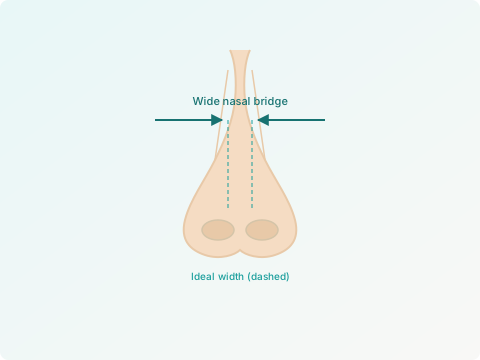
3D bone mapping
CT imaging maps the exact width, thickness, and asymmetry of the nasal bones. The surgeon plans precise osteotomy lines for controlled narrowing.
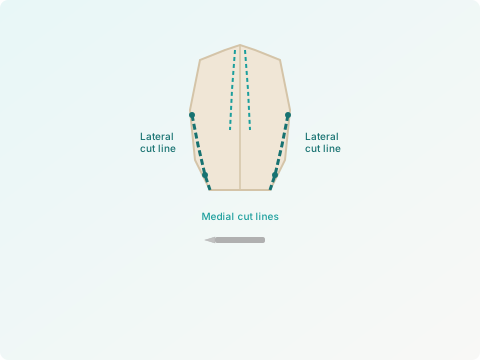
Controlled bone cuts
Using a fine osteotome inserted through small internal incisions, the surgeon makes lateral and medial osteotomies to free the nasal bone segments.
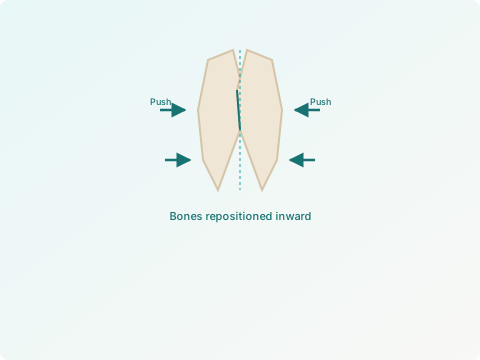
Bone repositioning
The freed bone segments are gently pressed inward to narrow the nasal bridge. Asymmetric cuts may be used to correct any pre-existing deviation.
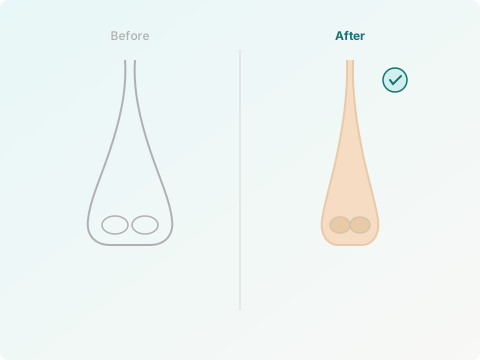
Stabilisation & splinting
An external splint and internal packing stabilise the repositioned bones. Patients avoid any nasal pressure for 4-6 weeks while the bones consolidate.
Cost · as of 2026
Through Seoul Medical Insider, rhinoplasty with osteotomy in Korea is quoted transparently. The price covers the full surgical team, general anaesthesia, the operating facility, the nasal splint, and follow-up appointments. No intermediary fees are charged.
Because osteotomy is almost always part of a comprehensive rhinoplasty, pricing reflects the overall surgical plan. Key cost drivers include whether the rhinoplasty involves dorsal work only or full bridge-and-tip reshaping, whether septoplasty (deviated septum correction) is performed simultaneously, the complexity of the bone asymmetry, and whether the case is primary or revision. Revision cases with prior osteotomies require more delicate bone handling.
All pricing is reviewed and confirmed as of 2026. Share front, profile, and base-view photos through our consultation form for a comprehensive quote.
Who it is for
Osteotomy is a structural technique — it is indicated whenever the nasal bones need to be repositioned as part of a rhinoplasty plan.
- Suited for: Patients with a wide nasal bridge (broad nasal bones) who want a slimmer, more refined frontal appearance.
- Suited for: Patients undergoing hump reduction — osteotomy closes the flat "open roof" left after the hump is rasped, restoring a smooth, narrow dorsum.
- Suited for: Patients with a crooked or deviated nasal bridge caused by asymmetric nasal bones — osteotomy straightens the bony vault.
- Discuss carefully: Patients with very thin nasal bones or a history of nasal fractures — the bones may fragment unpredictably, and the surgeon may need to use piezoelectric instruments for greater control.
- Discuss carefully: Patients expecting osteotomy alone to correct overall nasal width — in some cases the apparent width comes from thick soft tissue rather than wide bones, and osteotomy alone will not achieve the desired narrowing.
Recovery
- Week 1: The external nasal splint stays in place for 7 days. Periorbital bruising (raccoon eyes) is common and most pronounced on days 2 – 4, then gradually fades. Significant mid-face swelling occurs. Nasal breathing is blocked by internal swelling and any internal splints. Sleep strictly on your back with the head elevated. Do not blow your nose.
- Weeks 2 – 3: Splint is removed at day 7. Internal splints, if placed, are removed around the same time. The nose appears swollen and wider than the final result — this is normal. Bruising typically clears by the end of week 2. Gentle nasal saline irrigations begin. Social activities can cautiously resume.
- Weeks 4 – 8: Most visible swelling resolves. The bridge begins to show its narrower contour. Avoid any activity that risks impact to the nose. Do not wear glasses on the bridge. Light exercise can resume from week 4.
- Months 3 – 12: The nasal bones fully consolidate in their new position by month 3. Residual soft-tissue swelling, particularly in the supratip, resolves gradually over 6 – 12 months depending on skin thickness.
Plan a minimum 10-day stay in Korea. Splint removal (day 7) and a follow-up check (day 10) are critical. The surgeon assesses bone alignment and instructs you on nasal care before you travel. Avoid contact sports for at least 3 months.
Risks & considerations
Osteotomy is a controlled bone fracture and carries specific risks. Possible complications include asymmetric bone positioning resulting in a crooked-looking bridge, incomplete fracture causing a palpable step-off along the bone line, excessive narrowing making the nasal airway feel restricted, rocker deformity (one bone segment tilting inward while the adjacent segment tilts outward), greenstick fracture where the bone cracks but does not fully mobilise, prolonged periorbital bruising and swelling, numbness along the side of the nose from infraorbital nerve irritation, and rarely, delayed bone callus formation causing a visible or palpable bump. Piezoelectric osteotomy instruments, increasingly used in Korean clinics, reduce the risk of uncontrolled fractures and soft-tissue trauma.
Korea trip checklist
- Share front-view, profile, and bird's-eye (base) photos during your online consultation so the surgeon can evaluate your nasal bone width and symmetry.
- Discontinue all blood thinners, NSAIDs, and supplements (aspirin, ibuprofen, omega-3, vitamin E, ginseng, ginkgo) at least 10 days before surgery.
- Arrange accommodation within 20 minutes of the clinic for the first 10 days. You will attend splint removal (day 7) and a bone-alignment check (day 10).
- Stock up on saline nasal spray — you will use it frequently once cleared by the surgeon to keep the nasal passages moist and help clear dried blood.
- Bring button-front or zip-up clothing. Pulling shirts over your head can bump the nose and displace healing bones.
- If you wear prescription glasses, switch to contact lenses or prepare a forehead-resting glasses strap — no weight on the nasal bridge for 6 weeks.
- Plan for two weeks away from any high-visibility social or professional commitments — periorbital bruising from osteotomy is more pronounced than from soft-tissue rhinoplasty alone.
Clinical details are summarized from materials provided by SMI's partner clinics and published guidance from the Korean Society of Plastic and Reconstructive Surgeons (KSPRS). Technique selection is determined by your surgeon during consultation. SMI is a registered patient-facilitation agency, not a medical provider, and does not offer medical advice.
Why get this procedure in Korea
-
World-leading surgical volume
Korean plastic surgeons perform more facial procedures per capita than any other country, refining techniques through high case volumes.
-
Board-certified specialists
All SMI partner surgeons hold Korean Board of Plastic Surgery certification and operate at JCI or KOIHA-accredited facilities.
-
40-60% cost savings
Comparable or superior results at a fraction of US/EU pricing, with no compromise on safety standards or technology.
You may also consider
Related guides
- Rhinoplasty in Korea: The International Patient’s Cost & Surgery Guide A clear, educational guide to rhinoplasty in Korea for foreigners — procedure types, what drives cost, recovery, and how to choose a surgeon safely.
- Rhinoplasty Recovery in Korea: A Week-by-Week Aftercare Guide for International Patients Planning rhinoplasty in Korea? This guide walks you through the full recovery timeline—from the first 48 hours to final results—with practical aftercare tips tailored to international patients.
- Rhinoplasty Recovery in Korea Week by Week: Swelling Timeline, Splint Care, and What International Patients Should Expect A detailed week-by-week guide to rhinoplasty recovery in Korea, covering swelling progression, splint and stitch removal, aftercare for international patients, and when you can expect your final results to appear.
- How Long Should You Stay in Korea After Plastic Surgery? A logistics hub for international patients — typical recovery-stay windows by procedure, when you can safely fly home, and the visa and interpreter basics for a trip to Seoul.
Frequently asked questions
Sources
- Ministry of Health and Welfare, Republic of Korea
- Medical Korea (KHIDI)
- Korea Health Industry Development Institute (KHIDI)
- Korean Society of Plastic and Reconstructive Surgeons (KSPRS)
- International Society of Aesthetic Plastic Surgery (ISAPS)
Read our editorial policy to learn how we source and verify information.
