Procedure guide
Incision Double Eyelid Surgery in Korea
- Surgery time Around 0.5 – 1 hour
- Anesthesia type Local anesthesia with sleeping sedation
- Hospitalization Not required
- Face wash & makeup 7 days after surgery
- Post-surgery check-up 1 time (depending on the patient's condition)
- Stitches removal 7 days after surgery



Incision double eyelid surgery is the gold-standard method for creating a lasting, well-defined upper eyelid crease. Unlike the non-incision (buried suture) technique, this approach involves a precise incision along the planned crease line, allowing the surgeon to remove excess skin, reposition or reduce orbital fat, and create a strong adhesion between the skin and the levator aponeurosis. The result is a permanent, natural-looking double eyelid fold.
Korean plastic surgeons are globally recognised for their refined approach to double eyelid surgery, performing tens of thousands of cases annually. Their techniques emphasise a naturally proportioned fold that harmonises with the patient's facial structure rather than a one-size-fits-all crease height.
At a glance | |
Surgery time | 40 – 60 minutes |
|---|---|
Anaesthesia | Local with sedation (general available) |
Hospital stay | Outpatient — discharged same day |
Back to routine | 5 – 7 days (suture removal) |
Final result | 3 – 6 months as swelling fully resolves |
This page is for informational purposes. Individual results vary. A board-certified surgeon should evaluate your anatomy before any procedure.
How it works
Incision double eyelid surgery follows a carefully planned sequence to create a natural crease while addressing excess tissue.
- Planning & marking — The surgeon measures the desired crease height (typically 6 – 8 mm from the lash line) and marks the incision line with the patient sitting upright. Crease shape (in-fold, out-fold, or parallel) is confirmed.
- Anaesthesia — Local anaesthetic with light IV sedation is administered. The patient feels no pain during the procedure.
- Incision & tissue adjustment — A fine incision is made along the marked line. The surgeon removes a thin strip of excess skin if needed, trims the orbicularis oculi muscle, and repositions or debulks pre-aponeurotic fat pads to reduce puffiness above the crease.
- Crease fixation — The lower skin edge is sutured to the levator aponeurosis, creating a durable adhesion that forms the eyelid fold. Suture placement depth and spacing determine crease definition.
- Closing — Fine 7-0 or 8-0 nylon sutures close the incision. These are removed at the clinic 5 – 7 days post-op.
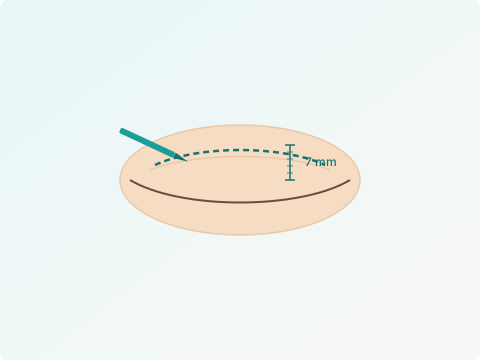
Crease design & marking
The surgeon measures eyelid thickness, fat volume, and levator function to determine the ideal crease height and shape for a natural double eyelid.
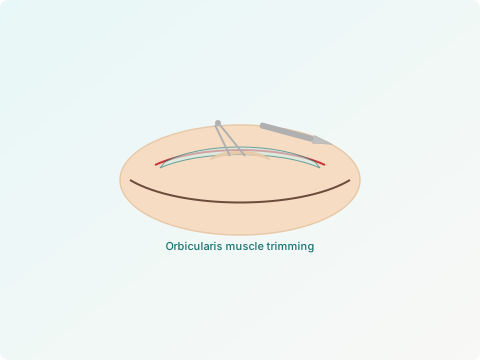
Incision & tissue adjustment
A fine incision is made along the marked crease line. Excess skin, orbicularis muscle, and orbital fat are carefully removed as needed.
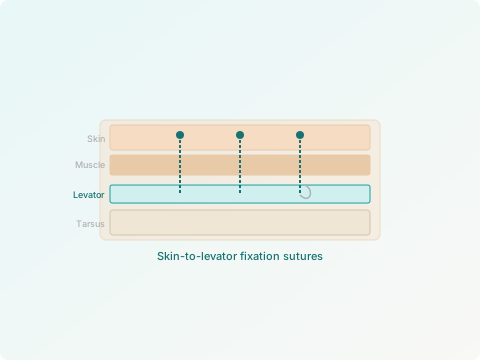
Crease fixation
The skin edge is sutured to the levator aponeurosis or tarsal plate, creating a permanent adhesion that forms the double eyelid fold.
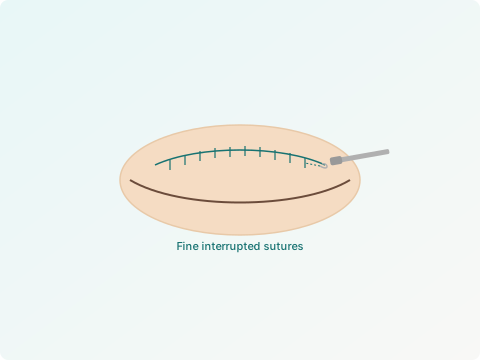
Closure & symmetry check
Fine sutures close the incision within the crease line. Both eyes are compared for symmetry in crease height and depth before completion.
Cost · as of 2026
Through Seoul Medical Insider, incision double eyelid surgery in Korea is quoted transparently with no hidden fees. The price includes the surgeon's fee, anaesthesia, facility use, and all standard follow-up visits. There is no markup — we provide the same rate the clinic charges its domestic patients.
Cost varies depending on the amount of skin removal required, whether fat repositioning or removal is included, and whether the procedure is combined with epicanthoplasty or ptosis correction. Revision cases from a prior surgery are typically higher due to scar tissue management.
All pricing is reviewed and confirmed as of 2026. Request a personalised quote through our consultation form for an exact figure based on your photos and goals.
Who it is for
Incision double eyelid surgery suits a wide range of patients, but it is especially effective when the eyelid has characteristics that non-incision methods cannot reliably address.
- Suited for: Patients with thick eyelid skin, significant excess upper eyelid skin, prominent pre-aponeurotic fat, a previous failed non-incision procedure, or those who want the most permanent and defined crease possible.
- Suited for: Patients over 35 with early upper eyelid hooding who want a crease and mild skin tightening in one procedure.
- Discuss carefully: Patients with very thin eyelid skin and minimal fat may achieve equivalent results with the less invasive non-incision technique and a shorter recovery.
- Discuss carefully: Patients with significant ptosis (droopy eyelid from weak levator function) — ptosis correction may need to be performed simultaneously for a safe and aesthetic outcome.
Recovery
- Week 1: Noticeable swelling and bruising around the eyes. The crease appears higher and tighter than the final result. Sutures are removed around day 5 – 7. Cold compresses and sleeping with the head elevated help reduce swelling. Avoid bending forward or straining.
- Weeks 2 – 3: Most bruising fades. Swelling reduces significantly but the crease line may still look pronounced. Light daily activities and desk work can resume. Avoid eye makeup and contact lenses until cleared by the surgeon.
- Weeks 4 – 8: The fold softens to a more natural appearance. Residual firmness along the incision line gradually resolves. Exercise can typically resume from week 4.
- Months 3 – 6: The final crease height and shape settle. The incision scar, hidden within the crease, fades to a nearly invisible fine line.
International patients should plan to stay in Korea for at least 7 days after surgery to attend the suture removal appointment and the initial healing check. Many patients feel comfortable flying home once sutures are out.
Risks & considerations
Incision double eyelid surgery is considered safe when performed by an experienced surgeon, but all surgical procedures carry some risk. Possible complications include asymmetry between the two eyelid creases (the most common reason for revision), an unnaturally high or deep fold if too much tissue is removed, visible or hypertrophic scarring along the incision line, prolonged swelling lasting beyond three months, under-correction resulting in a faint fold, difficulty closing the eyes fully in the early post-operative period (lagophthalmos — usually temporary), and very rarely, infection or haematoma requiring drainage. Choosing a board-certified Korean plastic surgeon with extensive double eyelid experience significantly reduces these risks.
Korea trip checklist
- Bring clear, well-lit photos of your eyes (open and closed, looking up) to share during your online consultation — this helps the surgeon evaluate your anatomy in advance.
- Stop taking aspirin, ibuprofen, vitamin E, and fish oil supplements at least one week before surgery to minimise bleeding risk.
- Arrange accommodation within 30 minutes of the clinic for the first week — you will return for suture removal and a healing check.
- Pack a pair of large sunglasses and a wide-brimmed hat for comfort and UV protection during your recovery walks.
- Bring preservative-free artificial tears; your eyes may feel dry in the first week after surgery.
- Book a return flight no earlier than day 7 post-op to ensure sutures are removed and the surgeon confirms safe healing before you fly.
- If you wear contact lenses, switch to glasses before travelling — you will not be able to wear contacts for approximately 2 – 3 weeks post-op.
Clinical details are summarized from materials provided by SMI's partner clinics and published guidance from the Korean Society of Plastic and Reconstructive Surgeons (KSPRS). Technique selection is determined by your surgeon during consultation. SMI is a registered patient-facilitation agency, not a medical provider, and does not offer medical advice.
Why get this procedure in Korea
-
World-leading surgical volume
Korean plastic surgeons perform more facial procedures per capita than any other country, refining techniques through high case volumes.
-
Board-certified specialists
All SMI partner surgeons hold Korean Board of Plastic Surgery certification and operate at JCI or KOIHA-accredited facilities.
-
40-60% cost savings
Comparable or superior results at a fraction of US/EU pricing, with no compromise on safety standards or technology.
You may also consider
Related guides
- Double Eyelid Surgery in Korea: A Complete Cost & Methods Guide A clear, educational guide to double eyelid surgery in Korea — incisional vs non-incisional, what drives cost, recovery, and choosing a surgeon.
- Double Eyelid Surgery in Korea: Incisional vs Non-Incisional Methods, Recovery, and Choosing a Safe Clinic A balanced comparison of incisional and non-incisional double eyelid surgery techniques offered in Seoul, covering candidacy, recovery timelines, accreditation standards, and practical guidance for international patients.
- How Long Should You Stay in Korea After Plastic Surgery? A logistics hub for international patients — typical recovery-stay windows by procedure, when you can safely fly home, and the visa and interpreter basics for a trip to Seoul.
- The Real All-In Cost of Plastic Surgery in Korea (Beyond the Quote) The surgery quote is only part of the bill. A clear, honest framework for the all-in cost of plastic surgery in Korea — every line item, plus how to avoid hidden fees and the foreigner price gap.
Frequently asked questions
Sources
- Ministry of Health and Welfare, Republic of Korea
- Medical Korea (KHIDI)
- Korea Health Industry Development Institute (KHIDI)
- Korean Society of Plastic and Reconstructive Surgeons (KSPRS)
- International Society of Aesthetic Plastic Surgery (ISAPS)
Read our editorial policy to learn how we source and verify information.
