
Procedure guide
Ptosis Correction in Korea
- Surgery time Around 0.5 – 1 hour
- Anesthesia type Local anesthesia with sleeping sedation
- Hospitalization Not required
- Face wash & makeup 5 – 7 days after surgery
- Post-surgery check-up 1 time (depending on the patient's condition)
- Stitches removal 5 – 7 days after surgery



Ptosis correction is a functional and aesthetic procedure that strengthens the muscle responsible for opening the upper eyelid. When the levator palpebrae superioris muscle is weak or its aponeurosis has stretched, the eyelid margin droops — covering part of the pupil, limiting the visual field, and giving the eyes a heavy, sleepy appearance. Ptosis correction restores full eyelid elevation so the eyes open wider and more symmetrically.
Korea is a world leader in ptosis surgery because it is frequently combined with double eyelid creation, requiring the surgeon to master both functional repair and aesthetic design simultaneously. Korean surgeons routinely fine-tune levator tension intra-operatively, often asking the patient to open their eyes during the procedure to confirm symmetry in real time.
At a glance | |
Surgery time | 40 – 70 minutes |
|---|---|
Anaesthesia | Local with sedation (patient must open eyes on request) |
Hospital stay | Outpatient — discharged same day |
Back to routine | 5 – 7 days |
Final result | 3 – 6 months |
This page is for informational purposes. Individual results vary. A board-certified surgeon should evaluate your anatomy before any procedure.
How it works
Ptosis correction targets the levator muscle or its aponeurosis to restore normal eyelid opening height. The specific technique depends on the severity of the droop.
- Assessment & planning — The surgeon measures the margin-reflex distance (MRD1) — the gap between the pupil centre and the upper lid margin. Normal is 3.5 – 4 mm; ptosis is diagnosed below 3 mm. The degree of ptosis (mild, moderate, severe) determines whether an aponeurotic advancement, plication, or Muller muscle tuck is used.
- Anaesthesia — Local anaesthetic is injected into the eyelid. Light sedation keeps the patient comfortable, but the patient remains responsive enough to open their eyes on cue so the surgeon can check lid height and symmetry intra-operatively.
- Access — An incision is made along the planned double eyelid crease line (anterior approach). Through this same incision the surgeon can both correct the ptosis and create the fold.
- Levator repair — The levator aponeurosis is exposed, shortened (advancement) or folded (plication), and re-attached to the tarsal plate at the precise tension that produces the target lid height. The patient opens their eyes so the surgeon can verify symmetry before locking the sutures.
- Closing — The skin is sutured with fine nylon. If double eyelid creation is combined, the crease fixation is performed simultaneously. Sutures come out at day 5 – 7.
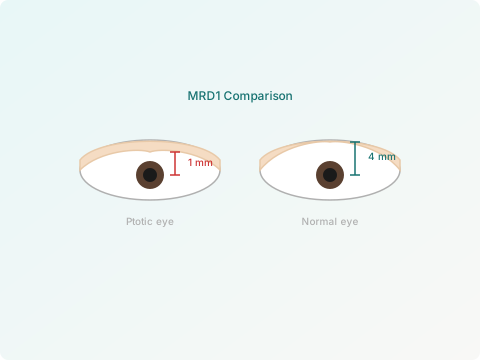
Levator function assessment
The surgeon measures the levator muscle excursion and margin reflex distance to determine the severity of ptosis and the required correction amount.
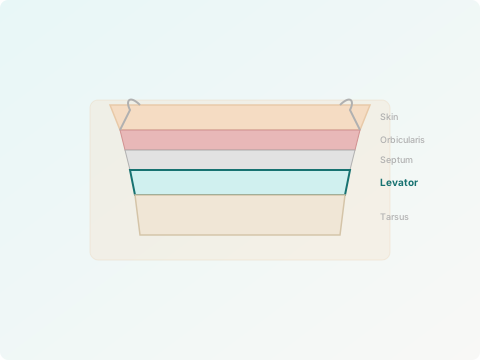
Muscle access & exposure
Through an upper eyelid incision, the surgeon exposes the levator aponeurosis or Mueller's muscle depending on the chosen technique.
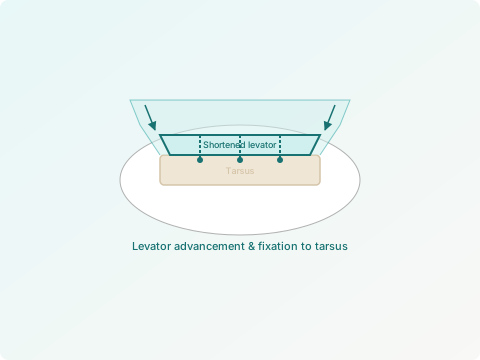
Muscle advancement or plication
The weakened levator muscle is shortened and reattached to the tarsal plate at the correct tension, restoring proper eyelid opening height.
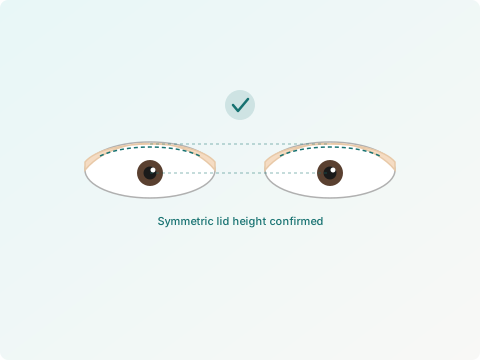
Intraoperative adjustment
The patient is asked to open their eyes during surgery so the surgeon can fine-tune the lid height and ensure both eyes match symmetrically.
Cost · as of 2026
Through Seoul Medical Insider, ptosis correction in Korea is priced transparently. The quote covers the surgeon's fee, anaesthesia, operating room, and follow-up visits — no hidden charges. Our fee is the same as what the clinic charges directly.
Price depends on whether ptosis correction is performed alone or combined with double eyelid surgery (the more common scenario), the severity of the ptosis, and whether the case is a primary procedure or a revision. Revision ptosis surgery is more complex because scar tissue around the levator must be carefully released before re-tensioning.
All pricing is reviewed and confirmed as of 2026. Contact us with front-facing and upward-gazing eye photos for a personalised quote.
Who it is for
Ptosis correction is one of the most functionally impactful eyelid procedures. It benefits both patients with a medical need and those seeking aesthetic improvement.
- Suited for: Patients whose upper eyelid covers part of the pupil, reducing the visible iris and causing a tired or asymmetric appearance.
- Suited for: Patients who unconsciously raise their eyebrows or tilt their head back to see better — signs of compensatory ptosis.
- Suited for: Patients seeking double eyelid surgery who also have mild ptosis — combining both procedures in one session produces a more open, balanced result.
- Discuss carefully: Patients with severe ptosis and very poor levator function (less than 4 mm of excursion) may require a frontalis sling technique instead of standard levator surgery.
- Discuss carefully: Patients with dry eye syndrome — ptosis correction increases the exposed ocular surface, which can worsen dryness. A Schirmer test should be performed pre-operatively.
Recovery
- Week 1: Significant swelling, especially in the first 48 hours. The eyelids will look over-corrected (very open) — this is expected and intentional because the lids settle as swelling resolves. Ice packs are applied for 48 hours. Sutures are removed around day 5 – 7. Eyes may feel stiff when blinking.
- Weeks 2 – 3: Swelling decreases substantially. The eyes begin to look more natural, though mild asymmetry during this phase is normal because the two sides heal at slightly different rates. Light activities and screen work can resume.
- Weeks 4 – 8: The lid height softens toward the final position. Residual tightness when closing the eyes at night usually resolves. Use lubricating eye drops before sleep if dryness persists.
- Months 3 – 6: Final symmetry and crease shape stabilise. The eyes appear naturally alert without looking surprised.
Plan a minimum 7-day stay in Korea. Suture removal and the first healing assessment must be done in person. If you are combining ptosis correction with other eye procedures, your surgeon may recommend extending your stay to 10 days.
Risks & considerations
Ptosis correction is generally safe but involves delicate manipulation of the levator muscle. Possible risks include asymmetric lid height (the most common issue, sometimes requiring a minor touch-up after swelling resolves), over-correction causing a startled appearance or difficulty fully closing the eyes (lagophthalmos), under-correction with persistent droop requiring reoperation, temporary or prolonged dry eye due to increased corneal exposure, contour irregularity of the eyelid margin, and very rarely, infection or deep haematoma. Because precise muscle tensioning is critical, choosing a surgeon with high-volume ptosis experience is especially important for this procedure.
Korea trip checklist
- During your online consultation, mention any history of dry eye, contact lens wear, or previous eyelid surgery — these affect the surgical plan for ptosis correction.
- Stop blood-thinning medications and supplements (aspirin, ibuprofen, omega-3, vitamin E, ginkgo) at least 7 days before surgery.
- Bring preservative-free artificial tears and lubricating eye ointment — your surgeon will likely recommend using both during the first two weeks.
- Reserve accommodation close to the clinic. You will need suture removal on day 5 – 7 and a healing check where the surgeon assesses lid height.
- Pack wraparound sunglasses to protect your eyes from wind, dust, and bright light during outdoor walks in Seoul.
- Do not schedule your return flight earlier than day 7. Cabin air is dry, which can aggravate post-op eye dryness, so carry lubricating drops for the flight.
- Prepare ice packs or gel masks at your accommodation before surgery day — you will need them for the first 48 hours.
Clinical details are summarized from materials provided by SMI's partner clinics and published guidance from the Korean Society of Plastic and Reconstructive Surgeons (KSPRS). Technique selection is determined by your surgeon during consultation. SMI is a registered patient-facilitation agency, not a medical provider, and does not offer medical advice.
Why get this procedure in Korea
-
World-leading surgical volume
Korean plastic surgeons perform more facial procedures per capita than any other country, refining techniques through high case volumes.
-
Board-certified specialists
All SMI partner surgeons hold Korean Board of Plastic Surgery certification and operate at JCI or KOIHA-accredited facilities.
-
40-60% cost savings
Comparable or superior results at a fraction of US/EU pricing, with no compromise on safety standards or technology.
You may also consider
Related guides
- Double Eyelid Surgery in Korea: A Complete Cost & Methods Guide A clear, educational guide to double eyelid surgery in Korea — incisional vs non-incisional, what drives cost, recovery, and choosing a surgeon.
- Double Eyelid Surgery in Korea: Incisional vs Non-Incisional Methods, Recovery, and Choosing a Safe Clinic A balanced comparison of incisional and non-incisional double eyelid surgery techniques offered in Seoul, covering candidacy, recovery timelines, accreditation standards, and practical guidance for international patients.
- How Long Should You Stay in Korea After Plastic Surgery? A logistics hub for international patients — typical recovery-stay windows by procedure, when you can safely fly home, and the visa and interpreter basics for a trip to Seoul.
- Is Plastic Surgery in Korea Safe? A Patient's Guide to Avoiding Ghost Surgery A balanced look at safety in Korea's plastic surgery industry — what ghost surgery is, the laws that protect you, and the checks every international patient should make before booking.
Frequently asked questions
Sources
- Ministry of Health and Welfare, Republic of Korea
- Medical Korea (KHIDI)
- Korea Health Industry Development Institute (KHIDI)
- Korean Society of Plastic and Reconstructive Surgeons (KSPRS)
- International Society of Aesthetic Plastic Surgery (ISAPS)
Read our editorial policy to learn how we source and verify information.
